Find out if your music will be turned down by YouTube, Spotify, TIDAL, Apple Music and more. Discover your music's Loudness Penalty score, for free.
Your file will not be uploaded, stored or shared, meaning this process is secure and anonymous.
We all hate sudden changes in loudness - they're the #1 source of user complaints.
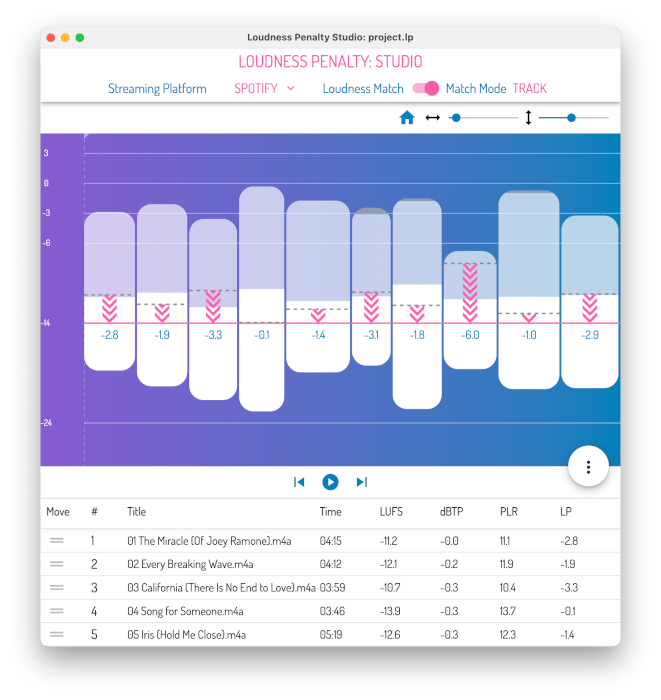
To avoid this and save us from being "blasted" unexpectedly, online streaming services measure loudness, and turn down music recorded at higher levels. We call this reduction the "Loudness Penalty" - the higher the level your music is mastered at, the bigger the penalty could be. But all the streaming services achieve this in different ways, and give different values, which makes it really hard to know how big the Loudness Penalty will be for your music...
Until now.
Simply select any WAV, MP3 or AAC file above, and within seconds we'll provide you with an accurate measurement of the Loudness Penalty for your music on many of the most popular music streaming services, and allow you to preview how it will sound for easy comparison with your favorite reference material.
Your file will not be uploaded, meaning this process is secure and anonymous.
Do you have any questions? Get in touch.
Find out how to optimize your music for impactful, punchy playback (and maximum encode quality) for all the online streaming services. Plus, receive a Loudness Penalty Report for your file that explains in detail what all the numbers mean.
Analyze another fileIn most jurisdictions, the use of cracked software violates copyright laws and End User License Agreements (EULA). While individual home users are rarely prosecuted compared to large-scale distributors, the legal framework exists to penalize those who bypass technological protection measures. Furthermore, businesses found using cracked software face massive fines and devastating reputational damage. 4. The Irony of Data Recovery Piracy
The search term "onesafe-data-recovery-crack-v10-2-0-0-key-2022" is a classic example of a "malware lure" —a deceptive phrase designed to trick users into downloading harmful software under the guise of a free program "crack" or license key. onesafe-data-recovery-crack-v10-2-0-0-key-2022
Harvesting saved passwords, banking details, and browser cookies. 2. The Ethical Dilemma In most jurisdictions, the use of cracked software
Beyond the technical risks lies an ethical question regarding intellectual property. Developing sophisticated software requires thousands of hours of engineering and significant financial investment. Using a crack is a direct act of theft from the developers. This creates a parasitic cycle: as piracy increases, developers may raise prices for legitimate users or implement more intrusive DRM, which in turn frustrates users and creates more demand for cracks. 3. Legal Consequences By introducing unverified
Allowing hackers remote access to their system.
The Illusion of Free: The Ethics and Risks of Software Cracks
There is a specific irony in seeking a crack for data recovery software. Users typically turn to these tools in moments of crisis—after a hard drive failure or accidental deletion. By introducing unverified, third-party code (a crack) into a system that is already unstable or compromised, the user significantly increases the likelihood of permanent, unrecoverable data loss. Conclusion